Hotel Sweet Hotel

One of many who can’t go home during the coronavirus

By Charis Lawson

Hope Mesngon is a Junior who lived in Terrace Apartments at the University of Maryland, Baltimore County (UMBC), but unlike most other college students living on campus, she can’t go home to ride out the COVID-19 pandemic.

Because her family lives in Texas, Mesngon was initially left self-isolating in a hotel room in Maryland, until she could move in with her aunt who also lives in Maryland. Like other college students dealing with the sudden change from a busy campus life to online learning, Mesngon is struggling to adjust. She misses the simple things, she says. 

“I even miss making eye contact with the professor,.”    

The transition is even harder for campus residents like Mesngon who must adjust to new living arrangements instead of returning home. Of those interviewed, 80 percent were sad to leave campus and the other 20 percent were conflicted. Most residents say that they miss their independence, their friends, and their freedom. 

Their abrupt change of lifestyle began on Wednesday, March 11, 2020, at 2:32 pm when a Residential Life email was sent to every  resident student at UMBC. Residential Life staff explained that no one should expect to be back on campus after spring break due to COVID-19. This was the first of a flurry of emails from Residential Life staff, providing specific information about  how housing and dining at UMBC would be affected by the pandemic. 

For students like Mesngon, who can’t return home for various reasons, ResLife offered some options. First, the student must fill out an application. Residential Life staff then comes together in a large conference room and discusses each application. The process of getting approved is difficult. 

“If someone says they have to stay on campus because they have a bad relationship with their parents, we have to dig deeper and ask how difficult that relationship is,” says Amery Thompson Community Director of Harbor. 

The Coronavirus had a greater effect than Mesgnon calculated. Mesgnon initially stayed in Maryland for an internship she would soon get laid off from due to COVID-19. Her spring break trip to Washington left her quarantining in a Hampton Inn from March 24th to April 7th, before going to stay with her aunt.  Now, the only thing keeping her from going home to Texas is getting her stuff from her apartment.

 “I understand that ResLife is doing what they think is best, but it is frustrating that I can’t go get my things,” she says, “especially since the items in my apartment helped give [me] a sense of comfort.” 

While residents were initially told that they could retrieve their possessions beginning April 3rd, Governor Larry Hogan’s stay at home directive means that all move-out plans have been canceled. 

“It’s back to the drawing board,” says Kaleigh Mrowka Assistant Director for Residential Education. 

Mrowka explains that the Residential Life staff doesn’t have much leeway in making decisions. Residential Life has to listen to the demands made by government officials, the encouragement of the council of Maryland schools, and the decisions of President Hrbrowski. 

As of April 20th, students are still unable to retrieve their belongings but UMBC has promised to refund all students money for housing, dining, and other fees for the remainder of the semester.
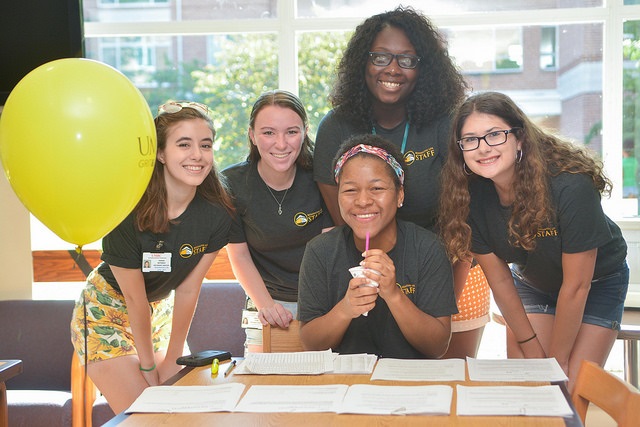
RAs pushback against Retriever chats

New policy mandating personal check ins raises concerns

by Charis Lawson

Residential Assistants Welcoming new Students : https://sites.google.com/?tab=i31

A controversial new policy requiring Resident Assistants (RAs) in all UMBC apartments and residence halls to document every interaction with residents on their floor is sparking heated discussion among Residential Life staff. 

Previously, only RAs in freshman dorms were required to perform and document weekly check-ins, called Retriever Chats. As of January 27, 2020, however, RAs in the apartments and residence halls populated by upperclassmen must also check in with a few residents in their hall every week and document every exchange.

RAs charged with carrying out the new policy say that expecting them to document each and every exchange with a fellow student is impractical — and mandatory weekly “Retriever Chats” will increase their workload, but the main concern is that it won’t feel natural or that documenting the chats is a breach in privacy. Residential Life encourages RAs to put general thoughts like ‘it was a positive interaction about how they were doing’ instead of divulging sensitive information. 

The expansion of Retriever Chats resulted from a decision made by the Curriculum Committee. The Curriculum Committee is composed of representatives from all residence halls and the apartments –both staff and student staff. Each hall/aprtment’s community director determines the number of resident interactions that must be documented. 

After weeks of discussion within the Curriculum Committee, they collectively decided to continue the mandatory interactions throughout the resident’s time living on campus. The committee’s main motivator is consistency. They want residents to feel support from RAs even when they aren’t freshmen. “ The check-ins are meant to serve as a way of engagement more than anything else. With that consistent support and check-ins we feel as though we are showing them what it takes to continue to grow as a person.” said Community Director Amery Thompson, a member of the Curriculum Committee. 

Due to the outcry amongst RAs when the new policy was announced during winter training, January the 24th 2020, Residential Life staff called a special meeting for RAs of apartments and upperclassmen halls to answer questions about the new policy and apologize for miscommunication. 

The meeting, held in the Meyerhoff lecture hall, was contentions. RAs asked why the policy had been implemented midway through the academic year and what counted as an “interaction.” Some expressed concern that they were being forced into conversation with students who had no interest in talking with them. They also felt that the new policy implied that they were not doing enough as RAs. Assistant Director of Residential Education Kaleigh Mrowka said that the new policy was a pilot run and asked student staff to do their best to implement it this semester. “Thank you for helping us out with this… Thanks for trying.” Mrowka said.

 Although opposition to the policy has quieted since the meeting. some RAs still resent the changes. In Harbor Hall, the vote for appreciating the changes versus disliking the changes was split down the middle fifty-fifty. Residents are torn too. “I think the sentiment of trying to interact with residents is good, but it should be more authentic… the interaction would most likely create a more strained relationship between RAs and residents.” said Briscoe Turner a resident of Hillside apartments.

Even RAs in freshman dorms doubt the effectiveness of mandatory Retriever Chats in the apartments. “I don’t despise the idea of it existing but maybe it could have been done in a different way, because the ways that people function in the apartments is different,”says Jessica Kweon a second semester RA in Potomac, a freshman hall. “In the halls, it is easy to say hi,” she said. Kweon wondered if switching the Retriever chats to a more practical or focused interaction would be more beneficial. 

Assistant Director of Residential Education David Clurman says that Residential Life welcomes feedback from RAs and residents on the program. While Residential Life is not likely to dismantle the program, they are open to ways to change it. The aim is “Connections” Clurman says. “With residents that’s the key. The goal [of Retriever Chats] is to form relationships.”

The Residential Life Office

by Charis Lawson

A waiting room housed by two receptionists is the first thing that one sees as he or she walks into the residential life office. Behind a door, guarded by the blinking swipe access lock is a hallway. Every two steps is a door housing a tiny office. Every single wall is crammed with brightly colored flyers and each tiny desk is warped with a computer screen. The clacking of keyboards is consistently muffled by the hum of the printer.

The hallway melts away into a large room. Two oval tables with rolling grey chairs surrounding it, seven cabinets of all shapes and sizes filled with assorted stamps, paint, colored paper, staplers, three computers, two printers; the residential life office is an arts and crafts paradise. Bulletin boards, paintings of UMBC, and colorful inventories decorate the walls.

At any given moment, the tables are occupied by Community Directors, Residential Assistants, and Faculty working within the same space.

If someone were to sit there for long enough, one could hear conversations of the bachelor, weekend conferences, new programs. A jumble of personalities, positions, and propositions housed within the same space.

Behind the large room, is the kitchen and to the side is another hallway with conference rooms and tiny offices for those who work in facilities. Of course, the place where students can code their new residential card is all the way in the back so the walk of shame allows the resident to interact with the maximum amount of people.

The residential life office is where the magic happens. Conduct, decorating, meetings, every issue has been brought within the confines of the residential life office. Information forms written up by RA’s come to the people working here. Programs are approved here. New ideas on how to run things are conceived here. Anyone who has ever been affiliated with res life has worked here at some time.

If inanimate objects could speak, I wonder what stories the walls could tell.

Edited February 11th so that the post doesn’t include the word “you”

Design a site like this with WordPress.com
Get started